
Slavery in Rome

Slaves in Rome: from the second century BC

The same loophole, offered by the self-esteem of free citizens, provides even greater opportunities to slaves in imperial Rome. The most privileged slaves are the secretarial staff of the emperor.

But these are the exception. In the two centuries before the beginning of the empire (the last two centuries BC) slaves are employed by Romans more widely than ever before and probably with greater brutality. In the mines they are whipped into continuing effort by overseers; in the fields they work in chain gangs; in the public arenas they are forced to engage in terrifying combat as gladiators. There are several slave uprisings in these two centuries, the most famous of them led by Spartacus.
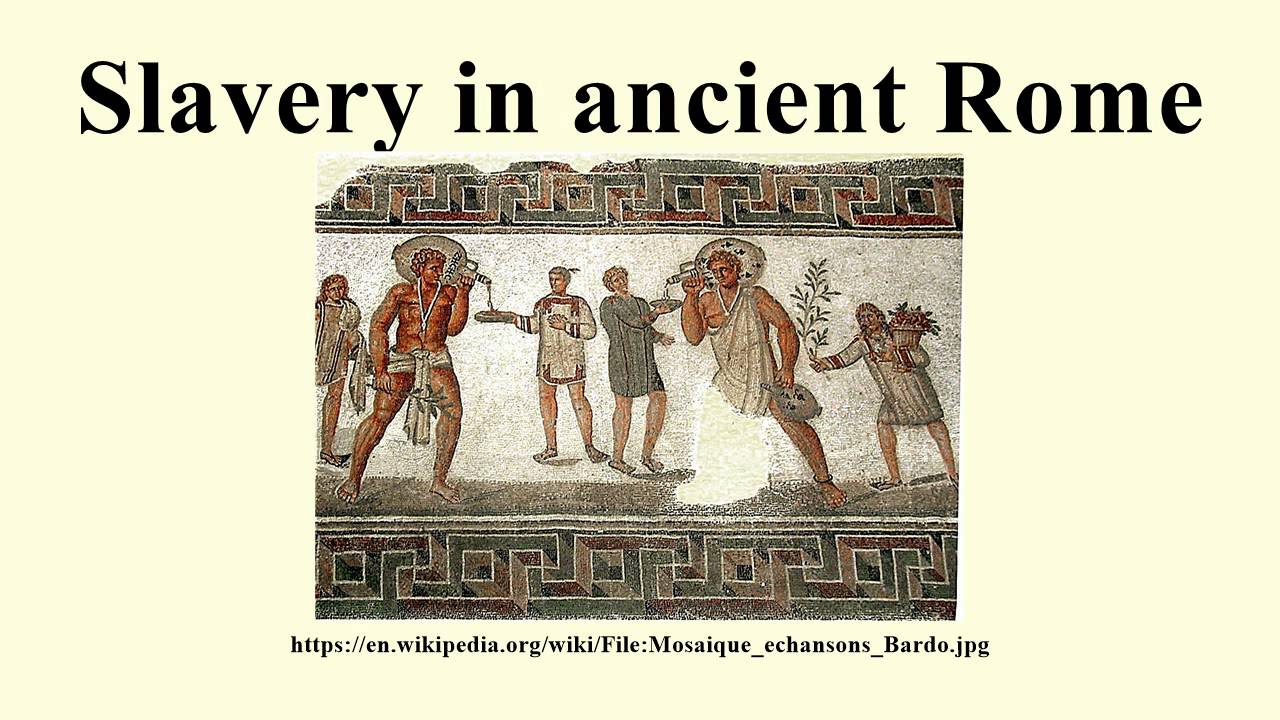
Image result for slaves in rome

Comments

Popular posts from this blog

The Portuguese slave trade:15th - 17th century

The Portuguese slave trade: 15th - 17th century The  Portuguese expeditions of the 15th century bring European ships for the first time into regular contact with sub-Saharan Africa. This region has long been the source of slaves for the route through the Sahara to the Mediterranean. The arrival of the Portuguese opens up another channel. Nature even provides a new collection point for this human cargo. The volcanic Cape Verde Islands, with their rocky and forbidding coastlines, are uninhabited. But they contain lush tropical valleys. And they are well placed on the sea routes between West Africa, Europe and America. Portuguese settlers move into the Cape Verde islands in about 1460. In 1466 they are given an economic advantage which guarantees their prosperity. They are granted a monopoly of a new slave trade. On the coast of Guinea the Portuguese are now setting up trading stations to buy captive Africans. Some of these slaves are used to work the settlers' estates in the Cape Ve...

Slavery in British India - Bengal

Slaves during the great Famine of Eastern India(above). Bengal trade, 1640-85. In Bengal the East India Company had established a factory at Hughly, hard by the dismantled Portuguese fortress; but were exposed to so much insolence and extortion from the Mogul authorities that they were prepared to leave Bengal rather than tamely submit to further oppression. The trade was enormously profitable, and had helped to defray the cost of the fortifications at Madras and Bombay. Saltpetre had been in large demand ever since the breaking out of the civil war between Charles the First and his parliament. Raw silk and opium were equally marketable, and all three products could be brought from Patna to Hughly by the river Ganges. At Dacca, the old capital of Bengal to the eastward of the Ganges, muslins were manufactured of so fine a texture that a piece sufficient for a dress might be passed through a wedding ring; and every young lady in the British Isles who aspired to be a bride w...

Slavery in Iran under the achaemenids

A  History of slavery  in  Iran  (Persia) during various  ancient ,  medieval  and  modern  periods is sparsely cataloged. commons.m.wikimedia.org/wiki/File:Record_of_the_sale_of_three_branded_slaves,_Achaemenid_Dynasty,_Iran,_c._455_BC_-_Royal_Ontario_Museum_-_DSC09610.JPG Under the Achaemenids Edit In general, mass slavery as a whole has never been practiced by Persians, and in many cases the situation and lives of semi-slaves (prisoners of war) were, in fact, better than those of the commoner. [1] Slavery was an existing institution in  Egypt ,  Media  and  Babylonia  before the rise of the Achaemenid empire. On the whole, in the  Achaemenid  empire, there was only small number of slaves in relation to the number of free persons and moreover the word used to call a slave was utilized also to express general dependence. [2] Usually, captives were prisoners of war that were recruited from...