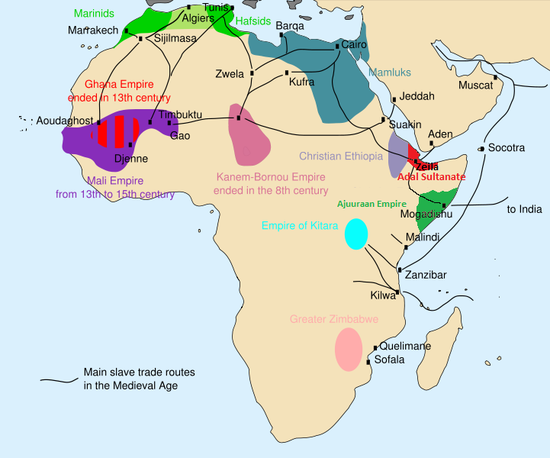
African and Arab slave trade

https://en.wikipedia.org/wiki/Arab_slave_trade
This trade flourished in Medival Africa and in the Arab World.
India is also included in this trade.

Comments

Popular posts from this blog

The Portuguese slave trade:15th - 17th century

The Portuguese slave trade: 15th - 17th century The  Portuguese expeditions of the 15th century bring European ships for the first time into regular contact with sub-Saharan Africa. This region has long been the source of slaves for the route through the Sahara to the Mediterranean. The arrival of the Portuguese opens up another channel. Nature even provides a new collection point for this human cargo. The volcanic Cape Verde Islands, with their rocky and forbidding coastlines, are uninhabited. But they contain lush tropical valleys. And they are well placed on the sea routes between West Africa, Europe and America. Portuguese settlers move into the Cape Verde islands in about 1460. In 1466 they are given an economic advantage which guarantees their prosperity. They are granted a monopoly of a new slave trade. On the coast of Guinea the Portuguese are now setting up trading stations to buy captive Africans. Some of these slaves are used to work the settlers' estates in the Cape Ve...

Profit made from slavery

The pursuit of profit The link between sugar and slavery established in Brazil spread to the British and French colonies in the Caribbean. In colonies such as Barbados, Jamaica and Saint-Domingue (modern day Haiti) outstanding profits were made on the backs of the enslaved African labour force. From 1500 to 1860 it is estimated that around 12 million enslaved Africans were traded to the Americas (3.25 million in British ships). Profits made on these voyages were often very large. For instance, in the seventeenth century, the Royal Africa Company could buy an enslaved African with trade goods worth £3 and have that person sold for £20 in the Americas. The Royal Africa Company was able to make an average profit of 38% per voyage in the 1680s. Although average profits on successful slave voyages from Britain in the late eighteenth century were less  –  at around 10%  –  this was still a big profit. The love of sugar that developed in Britain and other Eu...

Slavery in British India - Bengal

Slaves during the great Famine of Eastern India(above). Bengal trade, 1640-85. In Bengal the East India Company had established a factory at Hughly, hard by the dismantled Portuguese fortress; but were exposed to so much insolence and extortion from the Mogul authorities that they were prepared to leave Bengal rather than tamely submit to further oppression. The trade was enormously profitable, and had helped to defray the cost of the fortifications at Madras and Bombay. Saltpetre had been in large demand ever since the breaking out of the civil war between Charles the First and his parliament. Raw silk and opium were equally marketable, and all three products could be brought from Patna to Hughly by the river Ganges. At Dacca, the old capital of Bengal to the eastward of the Ganges, muslins were manufactured of so fine a texture that a piece sufficient for a dress might be passed through a wedding ring; and every young lady in the British Isles who aspired to be a bride w...